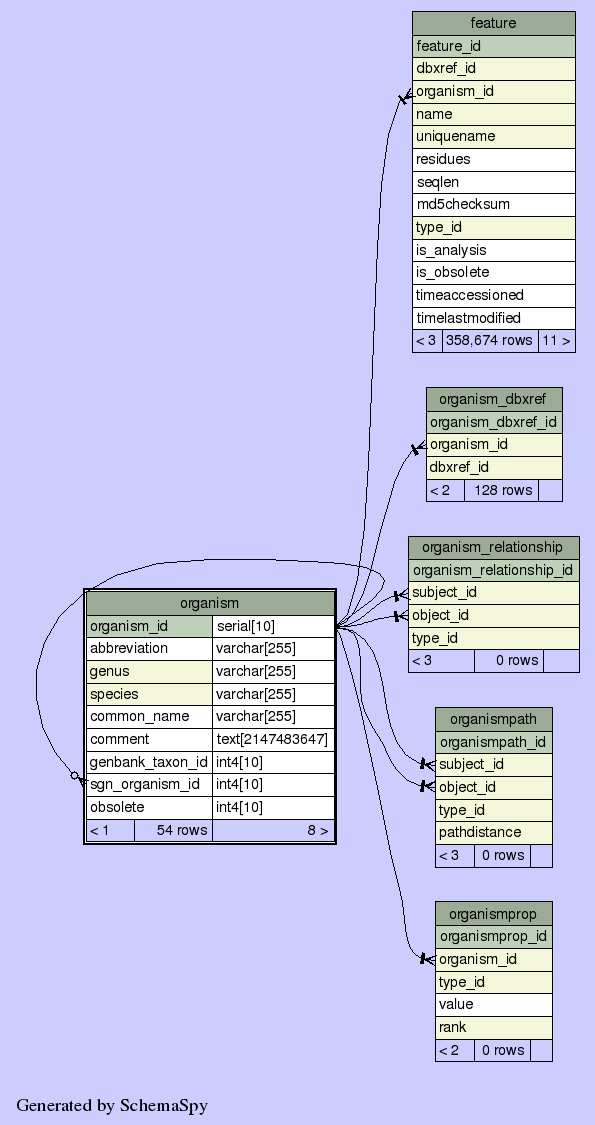
Table cxgn.public.organism

The organismal taxonomic
classification. Note that phylogenies are represented using the
phylogeny module, and taxonomies can be represented using the cvterm
module or the phylogeny module

Generated by
SchemaSpy
Related columns Constraint names Comments Legend
Legend: SourceForge.net
Primary key columns
Columns with indexes
Implied relationships
Excluded column relationships
Dashed lines show
implied relationships
< n > number of related tables
Please support this project 
Column Type Size Nulls Auto Default Children Parents Comments
organism_id serial 10  √  nextval('organism_organism_id_seq'::regclass)
feature.organism_id feature_organism_id_fkey
organism.sgn_organism_id organism_sgn_organism_id_fkey
organism_dbxref.organism_id organism_dbxref_organism_id_fkey
organism_relationship.object_id organism_relationship_object_id_fkey
organism_relationship.subject_id organism_relationship_subject_id_fkey
organismpath.object_id organismpath_object_id_fkey
organismpath.subject_id organismpath_subject_id_fkey
organismprop.organism_id organismprop_organism_id_fkey
abbreviation varchar 255  √  null
genus varchar 255
species varchar 255 A type of organism is always
uniquely identified by genus+species. When mapping from the NCBI
taxonomy names.dmp file, the unique-name column must be used where it
is present, as the name column is not always unique (eg environmental
samples). If a particular strain or subspecies is to be represented,
this is appended onto the species name. Follows standard NCBI taxonomy
pattern
common_name varchar 255  √  null
comment text 2147483647  √  null
genbank_taxon_id int4 10
sgn_organism_id int4 10  √  null
organism.organism_id organism_sgn_organism_id_fkey
obsolete int4 10  √  null

Table contained 54 rows at Wed May 20 01:40 EDT 2009

Indexes:
Column(s) Type Sort Constraint Name
organism_id Primary key Asc organism_pkey
genus + species Must be unique Asc/Asc organism_c1

Close relationships  within one two degrees of separation :