



The Petunia Lab at Radboud University, Nijmegen


Commercial Petunia line with "double" mutation.
For the nearly four years that we now have been in Nijmegen, The Netherlands, we have primarily focused on two themes in our Petunia research: meiosis-related research and MADS-box genes. We started on both topics when working in Ghent, Belgium in what was originally Prof Marc van Montagu's lab. Our group is small; each core subject is carried by a PI (Dr Janny Peters and Dr Michiel Vandenbussche respectively) and one or two PhD students (Veena Hedatale with Janny; Stefan Royaert and Anneke Rijpkema with Michiel) and supported by our fabulous technician, Jan Zethof, while two to five undergraduate students join the group for short periods of time. We are proud to have visiting scientists on sabbatical leave: Prof Dave Clark from Gainesville, Florida stayed with us for seven months in 2004 and presently Dr Tony Conner, from the Crop & Food Research/Lincoln University, Christchurch, New Zealand is with us for a year.
A large part of our research is funded by the Institute for Water and Wetland Research (IWWR). The IWWR aims to boost its competitive force by stimulating interdisciplinary co-operation between those engaged in the scientific fields of microbiology, ecology and plant- and environmental sciences (see http://www.iwwr.science.ru.nl/). Further funding is obtained from various national and international agencies. As one of the 'old' petunia labs we are part of the growing Petunia community and as such promote the use of this nice model system wherever we can (see: http://www.pg.science.ru.nl/ and http://www.petuniaplatform.net/ ). We do touch upon other organisms, like Arabidopsis if and when useful. One of the activities we are undertaking in compliance with the IWWR integrative research strategy is to initiate in-situ studies in Southern America to research upon the activity of (endogenous) transposable elements in natural Petunia axillaris accessions; a second activity under development is a study on the molecular genetics and ecology of the clonal propagation capacity of Petunia altiplana, seeds of which were kindly provided by Prof. Toshio Ando of Chiba University, Japan.
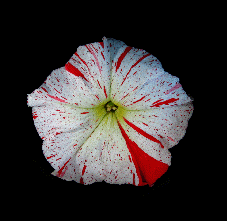
Transposon line W138
Now then, to describe in a few words our core research, I need to go a bit into Petunia as a system to work with; for details I refer to Gerats and Vandenbussche (2005), for now it suffices to state that Petunia has an easy and fast growth cycle, donates prolific material, is easy to transform, but maybe is most outstanding in its transposable element system, for which efficient forward and reverse strategies have been worked out.
MADS box research in Petunia is flourishing; in fact the D- and E functions were added to the classical ABC model, based on Petunia mutant analysis (the work of Gerco Angenents group). Meanwhile we are finally making progress in re-defining the A-function. One of the outstanding results of our group has been the development of the frameshift theory that states that 3' frameshift mutations may contribute structurally to the evolution of protein functions (Vandenbussche et al., 2003a). Presently we are finalizing the analysis of the B function genes. While Antirrhinum and Arabidopsis both have only one Glo/Pi and one Def/Ap3 gene, Petunia has two representatives of each lineage. A nice case of subfunctionalization and divergence. We are working on a systematic analysis of B function gene development within the Solanaceae (thanks to the marvellous Nijmegen collection we can sample a great range of SOL species: http://www.bgard.science.ru.nl/).
Finally, on the meiosis-related research, we have performed a partial cDNA-AFLP transcript analysis on developing Petunia Mitchell anthers from single flower buds that have been staged cytologically. Among the 480 meiosis-modulated gene fragments identified in this screen, there are around 65 that have a peak in expression in the early stages of meiosis, when the process of homologous recombination takes place. And that's the process in which we are most interested. Together with Prof Hans de Jong, Wageningen, we are analyzing SALK line insertants in genes, homologous to a number of the identified petunia genes. We have also joined forces on this subject with Keygene, the company that invented the AFLP procedures.
Contact Information
Dr. Tom Gerats
Radboud University, Nijmegen
The Netherlands
E-mail: T.Gerats@science.ru.nl

Seppallata mutant
Recent Publications
Petunia Ap2-like genes and their role in flower and seed development (2001). Maes T, Van de Steene N, Zethof J, Karimi M, D'Hauw M, Mares G, Van Montagu M, Gerats T. The Plant Cell 13 (2): 229-244
Analysis by Transposon Display of the behavior of the dTph1 element family during ontogeny and inbreeding of Petunia hybrida (2001). De Keukeleire P, Maes T, Sauer M, Zethof J, Van Montagu M, Gerats T. Mol Gen and Gen 265 (1): 72-81
A physical amplified fragment-length polymorphism map of Arabidopsis (2001). Peters JL, Constandt H, Neyt P, Cnops G, Zethof J, Zabeau M, Gerats T Plant Phys 127 (4): 1579-1589
AFLP maps of Petunia hybrida: building maps when markers cluster (2002). Strommer J, Peters J, Zethof J, de Keukeleire P, Gerats T. Theor and Appl Gen 105 (6-7): 1000-1009
Transcript profiling on developing Petunia hybrida floral organs (2003). Cnudde F, Moretti C, Porceddu A, Pezzotti M, Gerats T. Sex Plant Rep 16 (2): 77-85
Structural diversification and neo-functionalization during floral MADS-box gene evolution by C-terminal frameshift mutations (2003a). Vandenbussche M, Theissen G, Van de Peer Y, Gerats T. Nucl Acids Res 31 (15): 4401-4409
In silico identification of putative regulatory sequence elements in the 5 '-untranslated region of genes that are expressed during male gametogenesis (2003). Hulzink RJM, Weerdesteyn H, Croes AF, Gerats T, van Herpen MMA, van Helden J Plant Phys 132 (1): 75-83
Forward genetics and map-based cloning approaches (2003). Peters JL, Cnudde F, Gerats T. Trends in Plant Sci 8 (10): 484-491
Toward the analysis of the petunia MADS box gene family by reverse and forward transposon insertion mutagenesis approaches: B, C, and D floral organ identity functions require SEPALLATA-like MADS box genes in petunia (2003). Vandenbussche M, Zethof J, Souer E, Koes R, Tornielli GB, Pezzotti M, Ferrario S, Angenent GC, Gerats T. The Plant Cell 15 (11): 2680-2693
An AFLP-based genome-wide mapping strategy (2004). Peters JL, Cnops G, Neyt P, Zethof J, Cornelis K, Van Lijsebettens M, Gerats T. Theor and Appl Gen 108 (2): 321-327
A PCR-based assay to detect hAT-like transposon sequences in plants (2004). De Keukeleire P, De Schepper S, Gielis J, Gerats T. Chrom Res 12 (2): 117-123 2004
The Rg-1 encoded regeneration capacity of tomato is not related to an altered cytokinin homeostasis (2004). Boiten H, Azmi A, Dillen W, De Schepper S, Debergh P, Gerats T, Van Onckelen H, Prinsen E New Phyt 161 (3): 761-771
The duplicated B-class heterodimer model: Whorl-specific effects and complex genetic interactions in Petunia hybrida flower development (2004). Vandenbussche M, Zethof J, Royaert S, Weterings K, Gerats T. The Plant Cell 16 (3): 741-754
Ectopic expression of the petunia MADS box gene UNSHAVEN accelerates flowering and confers leaf-like characteristics to floral organs in a dominant-negative manner (2004). Ferrario S, Busscher J, Franken J, Gerats T, Vandenbussche M, Angenent GC, Immink RGH The Plant Cell 16 (6): 1490-1505
The rotunda2 mutants identify a role for the LEUNIG gene in vegetative leaf morphogenesis (2004). Cnops G, Jover-Gil S, Peters JL, Neyt P, De Block S, Robles P, Ponce MR, Gerats T, Van Lijsebettens M Journ of Exp Bot 55 (402): 1529-1539
STIG1 controls exudate secretion in the pistil of petunia and tobacco (2005). Verhoeven T et al. Plant Phys 138 (1): 153-160
A model system for comparative research: Petunia (2005). Gerats T, Vandenbussche M Trends in Plant Sci 10 (5): 251-256
Meiosis: Inducing variation by reduction (2005). Cnudde F, Gerats T Plant Biology 7 (4): 321-341 Quantitative Trait Locus (QTL) Isogenic Recombinant Analysis: a method for high-resolution mapping of QTL within a single population (2005). Peleman JD, Wye C, Zethof J, Sørensen AP, Verbakel H, Van Oeveren J, Gerats T, Rouppe van der Voort J. Genetics, 171: 1341-1352.
Working