



The Jahn Lab
The research in our group focuses on gene discovery, the analysis of genome structure and function and the relevance of this information for the improvement of useful plants. Work in our program includes fundamental studies of the relationship between model species and less well- characterized crop species, the release of varieties and advanced breeding lines, development of improved selection strategies, and research on the genetics of disease resistance and fruit quality. Specifically, a major effort in the lab is to demonstrate the extent to which results from a leading plant model, tomato, are relevant to the related, but much less well-characterized genus, Capsicum, the garden pepper. Towards this end we have developed a detailed comparative genetic map for the Solanaceae now defining the broadest comparative genetic system in the dicots. We have used this tool to identify candidates for traits with simple and quantitative inheritance and to assess the relationships between genes in tomato and pepper that affect similar or related traits. Further studies are focusing on traits considered distinctive
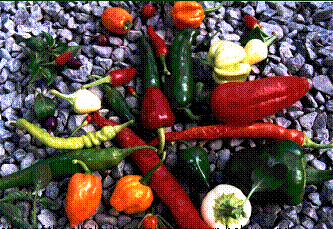
Different species and varieties of pepper for a genus, e.g., pungency.
Finally, the Solanaceae have afforded a unique glimpse of the organization of resistance genes in plant genomes. We have shown that despite co-evolutionary forces in host/pathogen interactions, disease resistance genes represent ancient lineages in plants and that resistance pathways may be very highly conserved. We also have extensive gene discovery and breeding activities that integrate classical and molecular methods for generating and selecting desirable genetic variability, primarily focused on the identification of new sources of biotic and abiotic stress resistance from wild accessions and related species in cucurbits, Phaseolus and pepper. The Public Seed Initiative is an outreach activity based on an alliance of public sector researchers and non-profit groups interested in improving the dissemination and utilization of public plant varieties and crop genetic diversity.
Pungency in pepper pods is a consequence of accumulation of the alkaloid capsaicin (shown below) and its analogs. The biosynthesis of capsaicin is restricted to the genus Capsicum and results from the acylation of an aromatic moiety, vanillylamine, by a branched chain fatty acid. Apart from portions of the biosynthetic pathway common to other primary metabolic pathways, the remainder of the pathway remains unknown. One of the major projects within our group focuses on capsaicin biosynthesis and the genes that define and regulate the pathway.

Molecular structure of capsaicin
Due to the popularity and familiarity of products containing capsaicin there is rapidly growing economic significance in a wide array of food products, in medicine, industry, law enforcement, and pest control (it has become a leading insect protectant in organic agriculture and is the active ingredient in many of the most effective deer and rodent repellents). Considering the importance of this pathway, it is surprising that relatively little is known, particularly at the molecular level, concerning the molecular genetics, biosynthesis, subcellular localization and cellular structures required for pungency accumulation in peppers. The recent cloning and initial characterization of Pun 1 (formerly known as C) allows for new insight into capsaicin biosynthesis and accumulation. pun 1 was first reported nearly 100 years ago and was shown to be epistatic to all other pungency-related genes (Webber, 1911). At present, the pun1 allele is the only confirmed mutation that has a qualitative affect on the presence/absence of capsaicinoids (Blum et al., 2002 and references therein). Further characterization of Pun 1, as well as other candidates implicated in pungency is currently underway.
Another area of research in our lab is potyvirus resistance. Mutations in the eIF4E homolog, encoded at the pvr1 locus, result in broad-spectrum potyvirus resistance conferred by pvr1 resistance allele in Capsicum, a gene widely deployed in agriculture. Point mutations in recessive resistance genes, pvr1, pvr11 and pvr12, grouped to similar regions of the eIF4E gene and were predicted by protein homology models to cause conformational shifts in the encoded proteins. While the protein encoded by pvr1+ interacts strongly, proteins translated from all three resistance alleles (pvr1, pvr11 and pvr12) failed to bind VPg from either strain of TEV in a yeast two hybrid assay. This failure to bind correlates with resistance, suggesting that interruption of the interaction between VPg and this eIF4E paralog may be necessary, but is not sufficient for potyvirus resistance in vivo. Among the three resistance alleles, only the pvr1 gene product fails to bind m7-GTP cap-analog columns, suggesting that disrupted cap-binding is not required for potyvirus resistance.
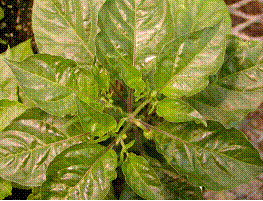
Uninfected pepper plant
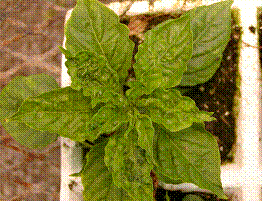
Pepper infected with Tobacco Etch Virus
Contact Information
Molly Jahn
Professor
313 Bradfield Hall
Plant Breeding and Genetics
Cornell University
Ithaca, NY 14853
mmj9@cornell.edu
607.255.8147
607.255.6683 (fax)

Selected Publications
Kang, B.-C., I.H. Yeam, J.D. Frantz, and M.M. Jahn. 2005. Mutations in translation initiation factor eIF4E that confer resistance to potyvirus infection abolish interaction with Tobacco etch virus VPg in a non- specific manner. Plant J. 42:392-405.
Stewart, C. Jr., B.-C. Kang, K. Liu, M. Mazourek, S. Moore, M.M. and Jahn. 2005. The Pun1 gene for pungency in pepper encodes a putative acyltransferase. Plant J. 42:675-688.
Liu, K., B.-C. Kang, H. Jiang, C.B. Watkins, T.L. Setter and M.M. Jahn. 2005. Identification and characterization of an auxin-responsive GH3- like gene in pepper fruit development. (accepted Plant Mol. Biol.).
E. A. Quirin, E. Ogundiwin, J.P. Prince, M. Mazourek, M. O. Briggs, T. S. Chlanda, K.T. Kim, M. Falise, B.-C. Kang, and M.M. Jahn. 2005. Development of sequence characterized amplified region (SCAR) primers for the detection of Phyto.5.2, a major QTL for resistance to Phtophthora capsici Leon. in pepper .Theor. Appl. Genet. 110(4):605-12.
Kang, B.-C., and I. H. Yeam, and M.M. Jahn. 2005. Virus resistance genes. Ann. Rev. of Phytopath. E. pub. May 2. 43:581-621.
Porch, T.G., M.H. Dickson, M. Long, D.R. Viands, and M.M. Jahn. 2005. General combining ability effects for reproductive heat tolerance in snap bean. J. Agriculture U. Puerto Rico 88(3-4):x-x.
Qian C.T., M.M. Jahn, J.E. Staub, X.-D. Luo and J.F. Chen. 2005. Meiotic chromosome behavior in an allotriploid derived from an amphidiploid x diploid mating in Cucumis. accepted Plant Breeding
Henning, M.J, H.M. Munger and M.M. Jahn. 2005. 'Hannah's Choice F1' : A new muskmelon hybrid with resistance to powdery mildew, Fusarium race 2 and potyviruses. HortScience in press.
Henning, M.J, H.M. Munger and M.M. Jahn. 2005. 'PMR Delicious 51': An improved open-pollinated melon with resistance to powdery mildew. HortScience 40(1):261-262.
Paran, I., J. Rouppe van der Voort, V. Lefebvre, M.M. Jahn, L. Landry, R. van Wijk, H. Verbakel, B. Tanyolac, C. Caranta, A. Ben Chaim, K.D. Livingstone, A. Palloix and J. Peleman. 2004. An integrated genetic map of pepper. Molecular Breeding 13:251-261.
Chen, J., X. Luo, C. Qian, M.M. Jahn, J.E. Staub, F. Zhuang, Q. Lou and G. Ren. 2004. Cucumis monosomic alien addition lines: morphological, cytological and RAPD analysis. TAG 108:1343-1348.
Alba, R., Z. Fei, P. Payton, Y. Liu, S.L. Moore, P. Debbie, J.S. Gordon, J.K.C. Rose, G. Martin, S.D. Tanksley, M. Bouzayen, M.M. Jahn and J. Giovannoni. 2004. ESTs, cDNA microarrays and gene expression profiling: tools for dissecting plant physiology and development. Plant J. 39:697-714
Rose, J.K.C., S. Bashir, JJ Giovannoni, MM Jahn and R.S. Saravanan. 2004. Tackling the plant proteome: practical approaches, hurdles and experimental tools. Plant J 39:715-733.
Nelson, R.J., R. Naylor and M.M. Jahn. 2004. The role of genomics research in the improvement of orphan crops. Crop Science 44:1901-1904.
Working