



The Seymour Lab
Kavita Kulkarni, Mervin Poole, Ken Manning, Graham B. Seymour,
Alex Popovich and Peter G. Walley
Fleshy fruits are economically highly valuable and provide a substantial part of the daily intake of vitamins and minerals whether they are consumed in a fresh or processed condition. There is evidence emerging that the genes that regulate ripening in fruits have been conserved during evolution. In our laboratory the aim is to isolate key members of this class of regulatory genes and investigate their role in ripening. There are three strands to our work in this area:
One approach is to clone the wild type allele of the gene responsible for the Colourless non-ripening (Cnr ) mutation of tomato. In tomato a small number of single gene mutations exist, such as rin, nor and Cnr which have pleiotropic effects resulting in the reduction or almost complete abolition of ripening. These probably represent lesions in ripening-regulatory genes. For instance Cnr results in a non-ripening phenotype with two distinct characteristics: (1) firm fruit with reduced cell-to-cell adhesion and (2) complete abolition of carotenoid biosynthesis in the pericarp (see Thompson et al. Plant Physiology 120: 383-389, 1999: Orfila et al. Plant Physiology, 126: 210-221, 2001). We have used a genetic map-based approach to isolate a candidate for the gene at the Cnr locus (Tör et al, 104: 165-170; 2002; Manning et al, manuscript in preparation) and want to understand its role in juiciness and colour development.
In collaboration with Jim Giovannoni at Cornell we are investigating whether strawberry orthologues of the tomato genes RIN and NOR can modulate ripening in this non-climacteric fruit. Mutant alleles of these genes have previously been used in conventional breeding to enhance texture and shelf- life in commercial tomato.
We are utilizing information from an advanced genetic framework in the dry fruited Arabidopsis to unravel the control of cell separation and softening in fleshy fruits. One of the tomato genes, TDR4, is a likely orthologue of the Arabidopsis gene FRUITFULL. In Arabidopsis this MADS-box gene is involved in the control of valve cell differentiation (the cells corresponding to the tomato pericarp). In ful mutants, valve cells adopt the fate of dehiscence zone cells, which are normally programmed to undergo cell separation when the fruit matures. (Ferrándiz, Liljegren and Yanofsky, 2000. Science 289, 436-438). We are testing whether TDR4 can substitute for FRUITFULL in Arabidopsis and investigating its role in tomato fruit ripening.
Other projects on-going in the lab include the identification and resolution of QTL for mechanical properties in tomato fruits and isolation of novel mutants affecting fruit quality.
Additionally GBS is spearheading, in collaboration with Gerard Bishop at Imperial College and Glenn Bryan at Scottish Crop Research Institute, the UK Solanaceae Research Community contribution to the International effort to sequence the tomato genome.

Redrawn and modified from The Evolution of Plants and Flowers,
B. Thomas, Eurobook Ltd, Wallingford, UK
Fleshy fruits are likely to have evolved from dry forms. Have genes controlling cell separation in ripening fruits been conserved during evolution.
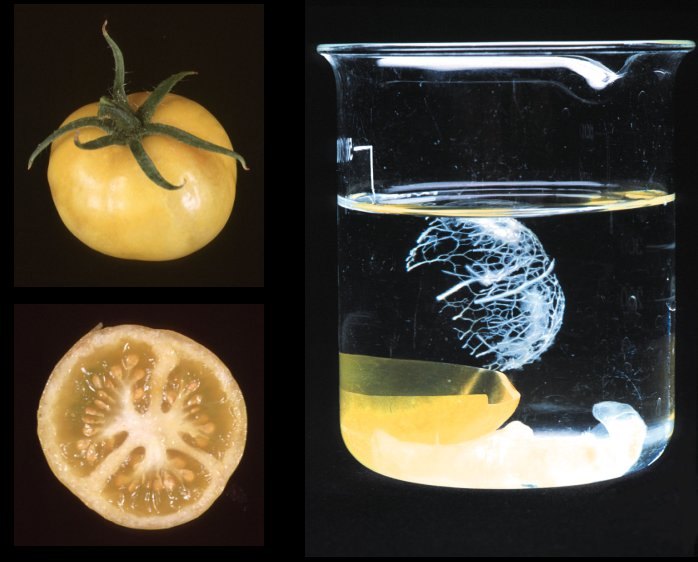
Colourless non-ripening (Cnr)
Cnr fruits show a non-ripening phenotype with significant loss of cell adhesion in the pericarp
Contact Information
Dr Graham B. Seymour
Warwick HRI
University of Warwick, Wellesbourne, Warwick CV35 9EF, UK.
Tel: 44 24 7657 4455
Fax 24 7657 4500
graham.seymour@warwick.ac.uk
Selected Recent Publications
Eriksson, E.M., Bovy, A., Manning, K., Harrison, L., Andrews, J., De Silva, J., Tucker, G.A. and Seymour, G.B. (2004). Effects of the Colourless non-ripening (Cnr) mutation on gene expression and cell wall biochemistry during tomato fruit development and ripening. Plant Physiology (submitted for publication).
Marin, C., Smith, D., Manning, K., Orchard, J. and Seymour, G.B. (2003). Pectate lyase gene expression and enzyme activity in ripening banana fruit. Plant Molecular Biology 51, 851-857.
Tor, M., Manning, K., King, G.J., Thompson, A.J., Jones, G.H., Seymour, G.B. and Armstrong, S. J. (2002). Genetic analysis and FISH mapping of the Colourless non-ripening locus of tomato. Theoretical and Applied Genetics 40, 165-170.
Fraser, P.D., Bramley, P. and Seymour, G.B. (2001). Effect of the Cnr mutation on carotenoid formation during tomato fruit ripening. Phytochemistry 58, 75-79.
King, G.J., Lynn, J.R., Dover, C.J., Evans, K.M. and Seymour, G.B. (2001). Resolution of quantitative trait loci for mechanical measures accounting for genetic variation in fruit texture of apple (Malus pumila Mill). Theoretical and Applied Genetics 102, 1227-1235.
Orfila, C., Seymour, G.B., Willats, W.G.T., Huxham, I.M., Jarvis, M.C., Dover, C.J., Thompson, A.J. and Knox, J.P. (2001). Altered middle lamella homogalacturonan and disrupted deposition of (1-5)-(-L- arabinan in the pericarp of Cnr, a ripening mutant of tomato. Plant Physiology 126, 210-221.
Drury, R., Hortensteiner, S., Donnison, I., Bird, C.R. and Seymour, G.B. (1999). Gene expression and chlorophyll catabolism in the peel of ripening banana fruits. Physiologia Plantarum 107, 32-38.
Huxham, I.M., Jarvis, M.C., Shakespeare, L., Dover, C.J., Juhnson,D., Knox, J.P. and Seymour, G.B. (1999). Electron energy loss spectroscopic imaging of calcium and nitrogen in the cell walls of apple fruits. Planta 208, 438-443.
Thompson, A.J., Tor, M., Barry, C.S., Vrebalov, J., Orfila, C., Jarvis, M.C., GiovannoniI, J.J., Grierson, D. and Seymour, G.B. (1999). Molecular and genetic characterisation of a novel pleiotropic tomato ripening mutant. Plant Physiology 120, 383-389.
Working